Writing may be the missing link that is preventing your students from leveling up their language abilities.

In my study of Mandarin Chinese, I often feel like my learning is characterized by long flat stretches of stagnation, punctuated by sudden, even unexpected increases in proficiency. As your students progress in their language learning journey, they likely will also encounter learning plateaus from time to time. I have found the best way to break through the glass ceiling of a proficiency plateau is through writing. Writing may be the missing link that is preventing your students from leveling up their language abilities.
Writing is the keystone of language development. Improving writing will support the development of all four domains: reading, listening, speaking, and writing. In an arch, the keystone is a special wedge-shaped rock that is placed at the top and in the center, allowing the entire structure to stand. In a similar way, writing supports the development of reading, listening, and speaking. I never fully understood the interwoven nature of the four domains of language until I learned the crucial role of writing. Let me share with you several strategies I have learned from my experience with Project GLAD that will show you how to integrate the four domains to produce writing of exceptional quality.
Marcia Brechtel, the founder of Guided Language Acquisition Design or Project GLAD, had an amazing vision of language development in the classroom. She understood that teachers need practical strategies with explicit instructions that script the instructional moves so that professional development has an immediate and sustainable impact. She developed the GLAD model around five domains: Focus and Motivation, Comprehensible Input, Guided Oral Practice, Reading and Writing, and Closure. Marcia’s book Bringing it All Together is a summary of the research and theory that the model is built upon. There are over 30 strategies with extensions, variations, and nuances that can leave teachers’ heads spinning after 7 days of training. In the intensity of the experience, some teachers miss the big ideas and end up instead doing strategies for the purpose of doing strategies rather than teaching with a vision of integrated language development. I have found that an emphasis on writing is the best way to help teachers keep their focus on the big picture and avoid getting caught up in the minutiae of individual strategies.

The GLAD Trinity
When I was a tier II GLAD trainer in training, I was blessed to have two expert trainers as my mentors. In order to make the big ideas of the GLAD model clear, one of my mentors taught me that GLAD has three core strategies: the Sentence Patterning Chart (SPC), Process Grid, and the Cooperative Strip Paragraph. These strategies work together to provide scaffolding EL’s need to produce grade-level writing. In practice, students use these three strategies together to scaffold their writing. I will always remember a religious metaphor my mentor gave me: she said these three strategies were like the Holy Trinity: they are three, but they work as if they were one. Each strategy develops language across all four domains, culminating in students producing a quality piece of grade-level writing.
The Sentence Patterning Chart
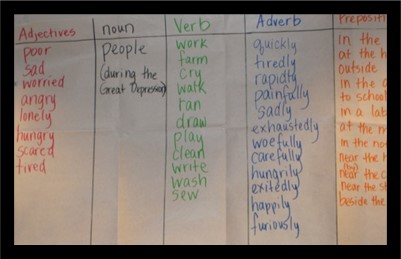
The SPC is often referred to as the “blue ribbon strategy” in Project GLAD because it is so useful and versatile. From the beginning of an instructional unit, teachers work with students to create a “language functional environment”, a classroom space where the walls are dripping with academic content and language. The walls are filled with comprehensible input constructed with the students including observation charts, inquiry charts, pictorial input charts, narrative inputs, chants, mind maps, all fully processed and made comprehensible with sketches, picture file cards, and realia that make the input comprehensible. In this environment, the teacher places a large sheet of chart paper in front of the class with five color-coded columns: adjective, noun, verb, adverb, prepositional phrase. The teacher provides one concrete noun, and the students talk with their partners to brainstorm parts of speech that support that noun. Students use the resources in the room and their own background knowledge to list each part of speech. Students then practice building sentences by chanting sentences to the song Farmer in the Dell. On another day the teacher plays the “Reading and Trading Game”. The teacher rewrites the parts of speech on sentence strips and hands them out to groups randomly. Students must negotiate with other groups to find all the parts of speech to make a meaningful sentence. The SPC can be added to later on, and as an extension, students can create their own SPC in teams and as individuals. The SPC is later used to help students embellish their writing.
The Process Grid
The Process Grid is a matrix that summarizes key information from the unit in a way that builds language through the content. It is the primary source of facts, examples, and details that support students in their independent writing. The matrix has content standards as titles for each column, and examples in each row. Teachers prepare for the process grid through an expert group jigsaw activity. The teacher invites small heterogeneous groups to read and discuss a text collaboratively. The expert group text emphasizes an example from each row of the process grid, and addresses each standard from the columns. The teacher and students read the expert group text chorally, and annotate the text together. They then summarize the expert group text on a graphic organizer. After each expert group has met, the experts share the information out orally to their peers. The teacher then leads the whole class in the “Process Grid Game”. The game proceeds very much like Jeopardy, with students sharing information from their expert groups orally. The teacher summarizes the responses in each cell of the process grid, awarding points for collaboration as experts support each other.

The Cooperative Strip Paragraph*
The GLAD Cooperative Strip Paragraph is whole class modeling of the writing process. It can be used as a whole class or in small groups. The teacher presents a mini lesson on writing, usually accompanied by a rubric or checklist, and invites the class to sit in front of a large pocket chart. The teacher places a topic sentence written on sentence strips at the top of the chart, and reads the sentence chorally with students, ensuring it is comprehensible through gestures or sketches. The teacher then goes through a process entirely unique to the GLAD model called “walking the walls”. The teacher directs students to review resources on the walls that support writing their paragraph. They review the SPC, the Process Grid, and all of the input charts, chants, and realia they have used to make the input comprehensible. The students then return to their groups and cooperatively develop one supporting sentence for the class paragraph. The teacher approves the sentence orally before inviting each group to write their sentence on sentence strips using a different color for each group. Each group places their sentence in the pocket chart, and the students are invited back up to the chart.
After an initial draft is complete, the teacher and students read the paragraph chorally, then the teacher invites the students to turn and talk to a partner about what they like and how they think it could be improved. The teacher then solicits suggestions for revision and performs the revisions in real time in front of the students. The teacher references various charts and resources from the walls to aid with the revision, always returning back to the rubric or checklist for guidance. Students are prompted to elaborate and embellish the writing with academic language they have learned. Students have the chance to participate in a metacognitive writing experience modeled as a whole class. They then can complete additional paragraphs in teams and as individuals. At the high school level I have used this strategy with Google Docs instead of sentence strips with success

After the writing process has been modeled for the whole class, students can be assigned additional paragraphs to complete as teams and later as individuals. When this process is followed effectively, students will have experienced multiple comprehensible interactions with the language of the content. Even students who are quite early in their production are able to engage in writing that is focused on grade level content standards. The engagement with the language though spaced repetition, using multiple modalities, is right on target with the research and best practices of language development.
There are other strategies that support students writing. The following are notable strategies that will be addressed in future posts:
- The Learning Log: a dialectical journal where students summarize their learning in the left column and make personal connections in the right column.
- Interactive Journal: A personal communication journal between student and teacher where students are invited to write or sketch to a prompt and the teacher responds.
- Writers Workshop: Based on the work of Lucy Calkins, writers workshop starts with a mini-lesson that emphasizes a discrete writing skill. Students then apply the skill and share their drafts during group discussions.
*This description was adapted from part of my Dialogue Entry 4. I share this to avoid plagiarizing my own words.
 Prolingual