Learning to Read Vs. Reading to Acquire

You don’t acquire the ability to read, but reading is the most effective way to acquire language.

After turning 40, I wanted to do something that would challenge me and push my life and career to a new level. With zero prior experience and no other motive than my own internal drive, I committed to learning Mandarin Chinese. I was already bilingual, with near-native proficiency in Spanish, so I knew it was possible. As a professional educator, I also wanted to learn more about the process of language learning, specifically how to break through the intermediate level to achieve a professional working proficiency. Six years of learning have taught me that extensive reading is the most powerful approach and the most effective use of my time.  While speaking, listening, and writing are important, extensive reading is the approach that will break the glass ceiling between you and upper levels of proficiency.

Unlike learning a new language, learning to read is not an acquired skill.  The human brain is designed to acquire language naturally through comprehensible input, and learns to reproduce language through feedback. Reading, on the other hand, is a skill our brains were not built for.  Reading requires us to commandeer parts of our brain that are used for other purposes, and repurpose them for reading. The fact that we are able to do this is a testament to the plasticity of the human brain, and the omniscience of its creator.

The fact that we are able to read is a testament to the plasticity of the human brain, and the omniscience of its creator.

So if we don’t acquire the skill of reading, why is reading so important to language acquisition? First, reading is the most effective way to acquire new vocabulary. The more you read, the more you increase the likelihood you will come across a word, structure, or grammar feature that will be helpful to your future understanding. Your brain prioritizes patterns it sees more frequently. Frequency of exposure is what linguists call spaced repetition. Language learning apps and flashcard systems use algorithms to maximize the effect of spaced repetition. The more you read, the more the act of reading becomes a natural spaced repetition system. This is especially true for reading longer texts such as chapter books and novels, or reading widely within a genre. Second, research has shown that reading can enhance every aspect of your linguistic repertoire, including your ability to listen, speak, and write.

Reading is your language learning superpower, if you can already decode text in your primary language.

Literacy experts talk about learning to read and reading to learn, but you seldom hear about reading to acquire. The reason reading to acquire language gets so little airtime is because the field of education is dominated by early literacy specialists who are focused on helping young children build oral language to learn to read, rather than helping literate adults use reading to build language. Reading is your language learning superpower if you can already decode text in your primary language. The power of reading to acquire language is further complicated by YouTube polyglots who make unrealistic claims such as you can become fluent in a new language in 3 months. Becoming truly proficient in a new language requires balance between receptive and productive modalities, but if you want to break out of beginner proficiency, the best way to do it is by increasing your reading time.  You will not click your way to fluency using an app.  You will not speak your way to fluency using a language partner. The most effective way to level up is through extensive reading.

Not all text is created equal, especially when it comes to reading to acquire a new language. For adolescents and adults who can already read in their primary language, extensive reading means selecting text that is very close to your comprehension level.  Research indicates that you should know 98% of the words in a text to maximize the impact of extensive reading.  That means only 1 word in 50 should be unknown! For beginners, it can be difficult to find text with such a limited corpus that is easy to read. Look for ‘Graded Readers’ in your new language. Graded readers (distinct from leveled readers meant for young children building foundational reading skills) are designed with a limited corpus and repeating patterns of words and grammar with slow and careful introduction of new language.  For intermediate learners, there are a lot of materials, but many are poorly graded.  An example of high quality graded materials in Mandarin Chinese is the Mandarin Companion Graded Reader series. Text that is poor quality, boring, beyond your level, or intended for elementary children learning to read in their primary language, will shut your reading interest down quickly, so be selective in choosing your text.

LingQ is the best app on the market for extensive reading. You will have to sift through the material as the quality varies, but it has the most extensive selection of materials that you can read and listen to.  You can also import content, which is a helpful feature for upper intermediate and advanced learners.  For beginners, stick to the curated content, and filter according to your interests.  It really is an effective way to build language.

Stay tuned to my blog as I have more to say about the best resources for learning a new language!

For the Love of Reading

Photo by Pixabay on Pexels.com

Extensive reading is sustained, fluent, enjoyable reading for the purpose of building language.

If you follow the news in public education, you have likely seen a national push for legislation aimed at improving early literacy instruction. The ‘Science of Reading’ movement advocates for better instructional materials and teacher preparation in evidence-based reading strategies, especially in foundational reading skills such as the explicit teaching of phonics. These changes are being codified into law in many states. Some literacy experts, like Natalie Wexler, are advocating for instructional materials that not only help students build foundational literacy skills but also expand their content knowledge. I support these efforts to enhance reading instruction, particularly for our most vulnerable populations. Yet, within the teach-and-test culture of public education, one crucial element is often overlooked: fostering a love of reading. When students reach the point where they can decode text and read for pleasure—around a Lexile measure of 700—they need time and space to enjoy reading. My hope is that the “science of reading” movement will embrace practices that enable students, especially new language learners,  to continue experiencing the joy of reading beyond the second grade.

My hope is that the “science of reading” movement will embrace practices that enable students, especially new language learners,  to continue experiencing the joy of reading beyond the second grade.

I began studying Mandarin Chinese with the goal of learning more about the language acquisition process to help me become a better teacher.  My biggest professional takeaway is the power of reading to improve language proficiency across all language domains: reading, writing, speaking, and listening.  Extensive reading is the single most powerful practice to acquire a new language. For a better view of my personal experience with extensive reading, please read my post on The Hidden Key to Learning a New Language.  As a teacher, I have consistently observed students who show limited progress in language development share a common trait: they rarely engage in reading for pleasure.  I have observed this same trend in adults who desire to improve their proficiency in a new or heritage language, but who have become stuck at the low-intermediate level.  As you strive to level up your proficiency, it will require sustained engagement in daily reading, particularly things that hold your interest. My top recommendation for elevating your language proficiency is to wholeheartedly embrace extensive reading.

Photo by Tima Miroshnichenko on Pexels.com

Extensive reading is sustained, fluent, enjoyable reading for the purpose of building language. It employs high interest, highly comprehensible texts in which readers recognize the vast majority of the words.  At early proficiency stages language learners use ‘graded readers’—which are different from ‘leveled readers’ used in early reading instruction. Graded readers are specifically designed with a limited vocabulary that frequently recycles vocabulary and grammar structures. As learners advance in their language proficiency, they gradually transition to more complex texts, and eventually to ‘authentic’ texts, which are not specifically tailored for language learners.

Photo by Element5 Digital on Pexels.com

Extensive reading is backed by decades of research, most of it coming from the English as a Foreign Language community.  Paul Nation is one of the most prominent researchers to promote this method, as was Stephen Krashen in his heyday. (See The Power of Reading by Stephen Krashen)  US educators are largely unaware of this body of research because our foreign language learning programs are a low priority compared to the rest of the world.  Additionally, the longstanding seesaw battle of the “Reading Wars” has created a false dichotomy, pitting authentic, language-building reading experiences against systematic phonics instruction. (See the You Can Learn Chinese Podcast, July 10, 2023) A misunderstanding of the science of reading has, ironically, prompted some teachers to abandon reading for pleasure as a strategy for building literacy.  The Common Core State Standards movement has added to the problem by shifting classroom practice to “close reading” (also called intensive reading) which involves reading and annotating complex texts rather than reading for enjoyment or pleasure. These pedagogical shifts have left no time allocated in the school day for what I consider the single most powerful language and literary building practice–extensive reading. These trends in literacy instruction relegate reading for pleasure primarily to the home rather than allocating dedicated time within the school curriculum.

From Kind-of-Compehensible to Totally Comprehensible

Celebrating a milestone in learning Mandarin.

I can read, write, speak, and listen comfortably on a range of topics in Chinese.

Six years ago I began conducting the greatest action research project of my life. In my early 40s and with zero prior knowledge, I determined I would learn Mandarin Chinese.  My purpose was to learn from firsthand experience what works and what does not work for learning a new language in order to help me grow as a high school teacher and college instructor.  This was not my first experience learning a new language. In my 20s I served a mission for the Church of Jesus Christ of Latter-Day Saints in Barcelona Spain. Later, as a high school teacher, I taught physical science and biology in Spanish at a bilingual high school in eastern Washington. Having achieved a high degree of proficiency in Spanish in a few years, I had no doubt I could do it again.  My goal was to become professionally proficient in Mandarin in five years.  Now, nearly six years later, I have achieved a solid low-intermediate proficiency.  I am officially an L-ChL or Long-Term Chinese Learner.  I can read, write, speak, and listen comfortably on a range of topics in Chinese, but I have a long way to go before I can engage with authentic native materials in a professional environment.  If you go by number of characters, I have about one third of the language I need to comfortably read a newspaper in Mandarin. Even though my timeline has been substantially extended, I am at precisely the level I need to be to learn what it takes to achieve escape velocity from the intermediate plateau. The value of this experience to my professional learning as a teacher of multilingual learners is immeasurable.

I have about one third of the language I need to comfortably read a newspaper in Mandarin.

Two methodologies have really stood out as effective approaches in my experience learning Mandarin: Teaching Proficiency through Reading and Storytelling (TPRS) and extensive reading. Most K-12 educators have never heard of these approaches because they are associated exclusively with the most neglected teaching discipline in the US–World Languages. I was especially impressed with the work of Terry Waltz, a Chinese teaching consultant and expert on TPRS instruction.  TPRS takes stories from everyday life and turns them into totally comprehensible language learning tools.  Through pre-teaching vocabulary (including using primary language), visuals (images, drawings, gestures, realia), and lots of repetition through a process called “Circling”, the teacher facilitates the creation of a story by the class.  These stories come from everyday experiences and are often silly, even bizarre. The result is learners walk away from the experience understanding virtually every word of input. Teachers then recycle the vocabulary and structures to create graded reading materials. By narrowing the scope of the corpus and emphasizing high frequency language, comprehension is maximized and language acquisition is accelerated.  The combination of totally comprehensible listening and engagement with extensive reading is astoundingly effective.

As a language learner I am incredibly frustrated by “kinda comprehensible” input. Even as a highly motivated adult learner, nothing shuts me down more quickly than a constant barrage of partially understood messages.

So my question is: Are there lessons to be learned from these methods that could help improve content instruction and language acquisition for students?   My answer is yes!  As a language learner I am incredibly frustrated by “kinda comprehensible” input. Even as a highly motivated adult learner, nothing shuts me down more quickly than a constant barrage of partially understood messages.  It is utterly exhausting to your brain!  Kind of comprehensible input is more demotivating than understanding nothing at all because it conditions you to give up over and over and over again. “Kinda comprehensible” is exactly what is happening in classrooms around the country.  In educators’ defense, I do not believe it is reasonable to suggest language learners will completely understand every portion of every lesson, but I do think it is reasonable that part of every lesson is totally comprehensible every day.  Multilingual learners should leave every instructional period knowing they have engaged effectively in learning something in their new language.

Writing Development: The Missing Link

Writing may be the missing link that is preventing your students from leveling up their language abilities.

Photo by Armin Rimoldi on Pexels.com

In my study of Mandarin Chinese, I often feel like my learning is characterized by long flat stretches of stagnation, punctuated by sudden, even unexpected increases in proficiency.  As your students progress in their language learning journey, they likely will also encounter learning plateaus from time to time.  I have found the best way to break through the glass ceiling of a proficiency plateau is through writing.  Writing may be the missing link that is preventing your students from leveling up their language abilities.

Writing is the keystone of language development.  Improving writing will support the development of all four domains: reading, listening, speaking, and writing.  In an arch, the keystone is a special wedge-shaped rock that is placed at the top and in the center, allowing the entire structure to stand.  In a similar way, writing supports the development of reading, listening, and speaking.  I never fully understood the interwoven nature of the four domains of language until I learned the crucial role of writing.  Let me share with you several strategies I have learned from my experience with Project GLAD that will show you how to integrate the four domains to produce writing of exceptional quality.

Marcia Brechtel, the founder of Guided Language Acquisition Design or Project GLAD, had an amazing vision of language development in the classroom.  She understood that teachers need practical strategies with explicit instructions that script the instructional moves so that professional development has an immediate and sustainable impact.  She developed the GLAD model around five domains: Focus and Motivation, Comprehensible Input, Guided Oral Practice, Reading and Writing, and Closure.  Marcia’s book Bringing it All Together is a summary of the research and theory that the model is built upon.  There are over 30 strategies with extensions, variations, and nuances that can leave teachers’ heads spinning after 7 days of training.  In the intensity of the experience, some teachers miss the big ideas and end up instead doing strategies for the purpose of doing strategies rather than teaching with a vision of integrated language development.  I have found that an emphasis on writing is the best way to help teachers keep their focus on the big picture and avoid getting caught up in the minutiae of individual strategies.

The GLAD Trinity

When I was a tier II GLAD trainer in training, I was blessed to have two expert trainers as my mentors.  In order to make the big ideas of the GLAD model clear, one of my mentors taught me that GLAD has three core strategies: the Sentence Patterning Chart (SPC), Process Grid, and the Cooperative Strip Paragraph.  These strategies work together to provide scaffolding EL’s need to produce grade-level writing.  In practice, students use these three strategies together to scaffold their writing.  I will always remember a religious metaphor my mentor gave me: she said these three strategies were like the Holy Trinity: they are three, but they work as if they were one.  Each strategy develops language across all four domains, culminating in students producing a quality piece of grade-level writing.

The Sentence Patterning Chart

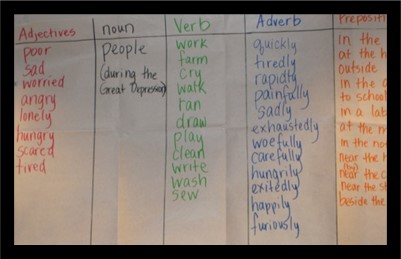
The SPC is often referred to as the “blue ribbon strategy” in Project GLAD because it is so useful and versatile.  From the beginning of an instructional unit, teachers work with students to create a “language functional environment”, a classroom space where the walls are dripping with academic content and language.  The walls are filled with comprehensible input constructed with the students including observation charts, inquiry charts, pictorial input charts, narrative inputs, chants, mind maps, all fully processed and made comprehensible with sketches, picture file cards, and realia that make the input comprehensible.  In this environment, the teacher places a large sheet of chart paper in front of the class with five color-coded columns: adjective, noun, verb, adverb, prepositional phrase. The teacher provides one concrete noun, and the students talk with their partners to brainstorm parts of speech that support that noun.  Students use the resources in the room and their own background knowledge to list each part of speech.  Students then practice building sentences by chanting sentences to the song Farmer in the Dell.  On another day the teacher plays the “Reading and Trading Game”.  The teacher rewrites the parts of speech on sentence strips and hands them out to groups randomly.  Students must negotiate with other groups to find all the parts of speech to make a meaningful sentence.  The SPC can be added to later on, and as an extension, students can create their own SPC in teams and as individuals.  The SPC is later used to help students embellish their writing.

The Sentence Patterning Chart

The Process Grid

The Process Grid is a matrix that summarizes key information from the unit in a way that builds language through the content.  It is the primary source of facts, examples, and details that support students in their independent writing.  The matrix has content standards as titles for each column, and examples in each row. Teachers prepare for the process grid through an expert group jigsaw activity.  The teacher invites small heterogeneous groups to read and discuss a text collaboratively.  The expert group text emphasizes an example from each row of the process grid, and addresses each standard from the columns.  The teacher and students read the expert group text chorally, and annotate the text together.  They then summarize the expert group text on a graphic organizer.  After each expert group has met, the experts share the information out orally to their peers.  The teacher then leads the whole class in the “Process Grid Game”.  The game proceeds very much like Jeopardy, with students sharing information from their expert groups orally.  The teacher summarizes the responses in each cell of the process grid, awarding points for collaboration as experts support each other.

The Process Grid

The Cooperative Strip Paragraph*

The GLAD Cooperative Strip Paragraph is whole class modeling of the writing process.  It can be used as a whole class or in small groups.  The teacher presents a mini lesson on writing, usually accompanied by a rubric or checklist, and invites the class to sit in front of a large pocket chart.  The teacher places a topic sentence written on sentence strips at the top of the chart, and reads the sentence chorally with students, ensuring it is comprehensible through gestures or sketches.  The teacher then goes through a process entirely unique to the GLAD model called “walking the walls”.  The teacher directs students to review resources on the walls that support writing their paragraph.  They review the SPC, the Process Grid, and all of the input charts, chants, and realia they have used to make the input comprehensible.  The students then return to their groups and cooperatively develop one supporting sentence for the class paragraph.  The teacher approves the sentence orally before inviting each group to write their sentence on sentence strips using a different color for each group. Each group places their sentence in the pocket chart, and the students are invited back up to the chart. 

After an initial draft is complete, the teacher and students read the paragraph chorally, then the teacher invites the students to turn and talk to a partner about what they like and how they think it could be improved.  The teacher then solicits suggestions for revision and performs the revisions in real time in front of the students.  The teacher references various charts and resources from the walls to aid with the revision, always returning back to the rubric or checklist for guidance.  Students are prompted to elaborate and embellish the writing with academic language they have learned.  Students have the chance to participate in a metacognitive writing experience modeled as a whole class.  They then can complete additional paragraphs in teams and as individuals.  At the high school level I have used this strategy with Google Docs instead of sentence strips with success

The Cooperative Strip Paragraph

After the writing process has been modeled for the whole class, students can be assigned additional paragraphs to complete as teams and later as individuals.  When this process is followed effectively, students will have experienced multiple comprehensible interactions with the language of the content.  Even students who are quite early in their production are able to engage in writing that is focused on grade level content standards.  The engagement with the language though spaced repetition, using multiple modalities, is right on target with the research and best practices of language development. 

There are other strategies that support students writing.  The following are notable strategies that will be addressed in future posts: 

  • The Learning Log: a dialectical journal where students summarize their learning in the left column and make personal connections in the right column.
  • Interactive Journal: A personal communication journal between student and teacher where students are invited to write or sketch to a prompt and the teacher responds.
  • Writers Workshop: Based on the work of Lucy Calkins, writers workshop starts with a mini-lesson that emphasizes a discrete writing skill.  Students then apply the skill and share their drafts during group discussions.

*This description was adapted from part of my Dialogue Entry 4.  I share this to avoid plagiarizing my own words.

How to Start Learning Mandarin

My recommendations for the best resources to start your language learning journey.

Photo by Oladimeji Ajegbile on Pexels.com

Several followers have asked me the same question: How do I start learning Mandarin? Let me share with you how I started, what I learned, and how you can avoid making the same mistakes.

I began my Mandarin learning journey by enrolling in a free online college-level course on edX. Created by Harvard and MIT, edX offers a wide range of university-level courses across various disciplines, and most of them are absolutely free. This platform provided me with a solid foundation and a good introduction to the language. The course comprised YouTube videos, exercises, and quizzes. However, after two months of regular study, I realized I needed more practice and feedback rather than just videos.

During my search for additional resources, I came across Fluent in 3 Months, a website run by “Benny the Irish Polyglot.” Initially skeptical about the claim of achieving fluency in three months, I decided to give it a chance. While achieving full fluency in such a short time frame is unrealistic, Benny’s program proved to be inspirational and energizing. It set the tone for the determination, commitment, and focus required to achieve proficiency in Mandarin Chinese. Although the Fluent in 3 program didn’t take me very far, it provided the momentum I needed to push through the initial phases of memorization.

To find a language learning app that offered practice and corrective feedback, I first tried Duolingo with limited success. Unsatisfied, I eventually invested in Rosetta Stone, the most popular language learning app on the market. However, I regretted this decision as Rosetta Stone provided zero explanation of complex patterns or structures. The company claimed that language is learned through exposure, similar to how babies learn. This approach proved ineffective, and I found myself relying on external resources and online searches to understand the language. Despite my frustrations, I persisted with the course for six months and managed to memorize approximately 300 words and phrases. However, I soon reached a plateau, and the law of diminishing returns set in. Pure memorization only takes you so far, typically around 300-400 words. For beginners, I recommend FluentU, which utilizes authentic media to build vocabulary and fluency through repeated exposure. They offer a 14-day free trial and are the best platform I have found for getting started in a new language.

Around one year into my language learning journey, I discovered ChinesePod, a platform that revolutionized my learning experience. ChinesePod offers 10-12 minute podcasts that present short dialogues, translations, and in-depth analysis in an entertaining manner. They also provide supplementary materials and extensions for further study. Listening to ChinesePod during my daily commute, combined with focused study time, transformed my language learning curve from flat to exponential. I experienced a shift from language learning to language acquisition, witnessing my proficiency grow month by month. While I haven’t found a comparable platform for learning Spanish, I’m currently working on a podcast concept to fill this void. Stay tuned for future updates!

After my breakthrough with ChinesePod, I decided to transition from learning Chinese pinyin to characters. To tackle the challenge of Chinese orthography, I turned to an electronic learning platform called ChineseSimple HSK1. This was a necessary step, as brute memorization is the primary approach for dealing with Chinese characters. Over a couple of months, I built a foundation of nearly 200 characters. Subsequently, I discovered the Mandarin Companion graded reader series, which features entry-level novels based on 150 characters. Although it was challenging at first, using Google Translate and perseverance allowed me to progress. Within three months, I was surprised to find myself reading simplified texts fluently in Mandarin Chinese. The process of language acquisition gained significant momentum.

To summarize, I recommend starting with the Fluent in 3 challenge by Benny and utilizing electronic platforms to build your vocabulary to around 300-400 words. FluentU is an excellent resource for this purpose and beyond. ChinesePod is the best resource on the market for comprehensible listening input. As soon as you are ready for characters, jump into reading with the Mandarin Companion Breakthrough series. Stay tuned to my blog for more opportunities and updates.

Mind Over Mattress

Photo by Jaymantri on Pexels.com

It’s 4:59 AM and your alarm is set to go off in 1 minute. Your brain automatically wakes you from an all-too-short night’s rest in dreadful anticipation. You now have a choice: you can reset your alarm and take that extra half hour to sleep, or you can drag yourself to your study nook and do your language study. This battle plays out on my mattress every single morning. Most of the time I win, and admittedly, every once in a while, I lose. The question I ask myself each morning is the same: how much do you want it? I want it enough to get up 30 minutes earlier than I have to so I can study. I want it enough to lose some sleep, even when I desperately need more. It’s a battle of wills–mind over mattress!

One of the questions people often ask me is how much time do you have to study to become proficient in Mandarin. I am not going to lie, learning a new language takes commitment, dedication, and consistency. It’s very similar to exercise, you have to set aside significant time each day to do it. If you are hoping to make meaningful progress, you should be studying a minimum of 30 minutes each day in your target language, and ideally a full hour. Don’t be duped by programs that claim you can learn a language in 5 minutes a day. You won’t get any further studying language 5 minutes a day than you will exercising for as much time. It’s the law of the harvest: you reap what you sow.

But unlike your exercise routine, your daily language study doesn’t need to happen all in one setting, and you hopefully will not need to shower afterward. My study routine includes 30 minutes of extensive reading in the morning, 10 minutes of vocabulary and grammar drills during my lunch break, and 20 minutes of reading and/or drills in the evening before bed. I also listen to language learning podcasts on my way to and from work and while doing chores at home. All told I can usually cram in a solid hour of focused study, and half hour of passive listening. To be clear, sustained, focused study is absolutely essential to effective language learning. Those commercials for apps where you see people practicing a language while jogging–pure propaganda. You won’t learn any more language while jogging than you will calculus; you need sustained focused study time.

So please send me a comment answering this question: What does your study routine look like? What are you willing to sacrifice in order to have time to study? How do you win the battle of mind over mattress?

The Hidden Key to Learning a New Language

What I am about to share with you will forever change your approach to learning a new language.

This is only my second post, but I just can’t keep this to myself.  It’s time to let the cat out of the bag. What I am about to share with you is the hidden key to achieving proficiency in a second language. Your high school foreign language teacher didn’t tell you the secret because they likely didn’t know it. (I mean, how much did you really learn from your high school foreign language teacher anyway?) You won’t hear about this secret from Rosetta Stone or Duolingo or Babbel because they don’t want you to know it. This secret is the main reason why you will not learn a new language the same way a child does, and why these electronic learning platforms will not get you very far in your journey toward proficiency in a new language.

While young children have massive advantages by nature and nurture for learning new languages, you have access to a powerful language learning machine that children do not use well until adolescence.  This machine is so powerful that once you learn how to leverage it for language learning, everything else will seem like a waste of time. I am speaking of your ability to read.

When my teenage son was just a toddler, we stopped one day at a construction site to watch the massive earth moving machines as the workers prepared the ground for a construction project. I watched in awe at the sheer amount of earth these machines were able to move. Yet off to the side, there were a few workers digging around with shovels. The contrast between the volume of earth moved by the machines versus the shovels made me ask myself, why would anyone ever want to use a shovel at all?  Shovels will always be important tools on construction sites, but the volume of work is far too vast to accomplish without powerful machines.  When it comes to learning a new language, most people are trying to level the ground for a skyscraper using nothing but a shovel.

Language learning apps and grammar books that focus on memorizing words and phrases out of context are the shovels of language learning. Don’t be fooled by the bells and whistles, a shovel is a shovel. Sure, there are shovels of different shapes and sizes, and some might move a little more dirt than others, but none of them compare to the massive amount of language learning you can experience when you get behind the wheel of the reading bulldozer!

Reading extensively in your target language is the most powerful thing you can do to progress toward proficiency. Extensive reading will help you improve by leaps and bounds in every domain of language including listening, speaking, and writing. If you are just beginning your journey, you may have to use a shovel until you are ready to fire up the bulldozer. But as you learn from my experience, you will see that everything you are doing as a novice language learner should be preparing you for the day when you can begin to read increasingly complex texts in your target language.

Those of you who come from a professional educator background may be questioning why I assert extensive reading rather than oral language is the key to acquiring a new language. Oral language is still very important for adults learning a second language, but short of moving to a foreign country, most of us must rely on extensive reading for a constant stream of comprehensible input. More on tools for developing oral language in a future post.

So what exactly is extensive reading, and why is it so powerful? I will explain that in my next post. In the meantime, whatever you do, please do not go out and buy a bunch of children’s books or leveled readers meant to teach early elementary students how to read. These books will not help you learn a second language as an adult. Wait for my next post, and I will teach you how to drive a bulldozer!